
Book tours, find deals, and explore Phuket – all in one place.


Inside the app, you will find a promo code for a discount on your first tour!
Standing on a Phuket street with a driver quoting 600 baht for a ten-minute ride, and wondering whether that is the real price? You are not the only one — tuk-tuk fares here are the single most common thing travelers argue about.
In this article we cover everything you need to know about taking a tuk-tuk in Phuket: what each route actually costs, how to agree the price before you get in, the tricks that turn a 200 baht ride into a 700 baht one, and when another way of getting around is simply cheaper.
What a Phuket Tuk-Tuk Actually Is
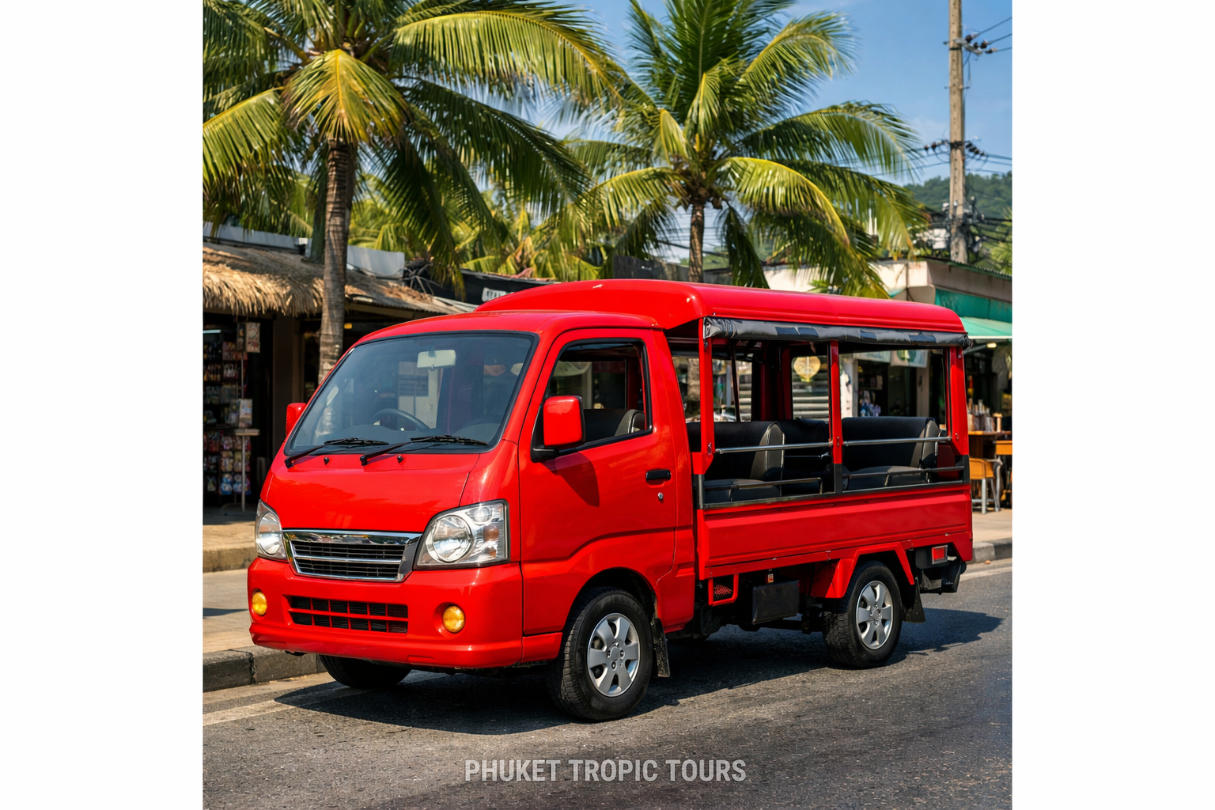
If you know the three-wheeled tuk-tuks of Bangkok, Phuket will surprise you. Here a tuk-tuk is a small four-wheeled van with an open back, usually painted red or yellow, with two bench seats and a roof.
The important part is not the shape but the pricing. Phuket tuk-tuks have no meters and never have. Every fare is a negotiation, agreed out loud before you climb in, and the quote you hear depends on where you are standing, what time it is and how confident you sound.
They are also a closed local business. Drivers work stands tied to specific beaches and hotels, which is why fares here are noticeably higher than in Bangkok or Chiang Mai for the same distance. Knowing that in advance saves a lot of frustration.
Tuk-Tuk Prices in Phuket by Route
There is an official maximum-fare board, approved by the provincial authorities, and you will see versions of it posted at tuk-tuk stands. Those numbers are ceilings, not fixed prices — you can and should negotiate below them.
Here is what the board says, and what people actually pay in practice.
Short Hops Inside Patong
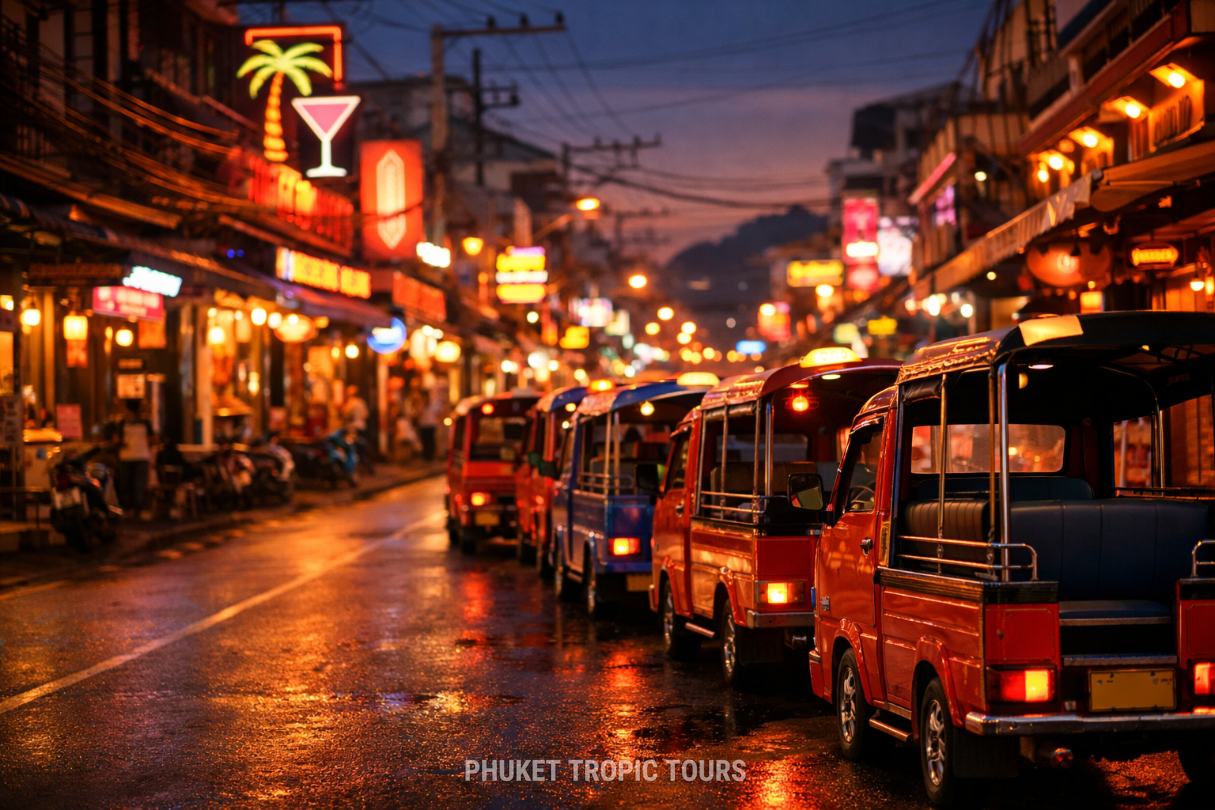
Inside Patong the going rate is 200 baht for any distance — from the beach road to Bangla, from your hotel to Jungceylon. It does not matter that the ride takes four minutes.
That 200 baht is per vehicle, for up to about six people, not per person. Drivers near the busiest corners will open at 300 or 400 baht; walking one street back from the beach road usually brings the quote straight back down to 200.
Beach to Beach
Distances between the west-coast beaches are short, but the fares are not. Typical prices:
- Kata to Karon — 200 baht (under 3 km)
- Karon to Patong — 400 baht
- Kata to Patong — 400 to 500 baht
- Patong to Kamala — 400 baht
- Patong to Surin — 500 baht
- Karon to Kamala — 600 baht
Tip: agree the return trip separately, at the moment you need it. A driver who promises to wait an hour for free will often quote a new, higher price on the way back.
Phuket Town and the Airport
Longer runs are where the difference between a tuk-tuk and an app really shows. Patong to Phuket Town is around 500 baht, Karon to Phuket Town around 550 baht, and Patong to Chalong about 500 baht.
Airport runs are the extreme: 800 baht from Patong, up to 1,000 baht from Karon and Kata. For arrivals with luggage this is rarely the right choice — a pre-booked transfer or a metered app car is usually both cheaper and calmer. Our Phuket airport arrival guide walks through the options in detail.
How to Agree the Price Before You Get In
The whole system rests on one rule: the price is settled while your feet are still on the pavement. Once you are sitting down with your bags loaded, your bargaining position is gone.
What works, in order:
- Name the destination clearly and ask "how much?" — let the driver quote first.
- Counter with the board price for that route, calmly and without drama.
- Confirm out loud that the price is for the whole car and for everyone in your group.
- Say you want to go straight there, with no stops.
- Have the exact amount ready in small notes.
If the quote stays high, thank the driver and walk. There is almost always another tuk-tuk within sight, and the second quote is usually better than the first. Being unhurried and friendly gets you further here than being firm.
Where Tourists Overpay
Almost every overcharge in Phuket comes from one of four moves, and all four are easy to shut down before they start.
Charging per person. The fare is for the vehicle. A driver who quotes 200 baht and then asks for 200 from each of your four friends is inventing a rule that does not exist.
The shop detour. A jewelry shop, a tailor, a "government tourist office" on the way. These stops pay the driver a commission and cost you an hour. Say at the start that you are going to one place only.
The night premium. After the bars close, fares around Bangla Road climb steeply and the usual 200 baht hop can be quoted at 400 or 500. It is real and it is not going away — factor it into your evening, or agree the ride home before you go out.
No change. Handing over a 1,000 baht note for a 200 baht ride frequently produces a driver with no change and a shrug. Break big notes at a 7-Eleven before you travel.
When Grab, the Smart Bus or a Songthaew Is Cheaper
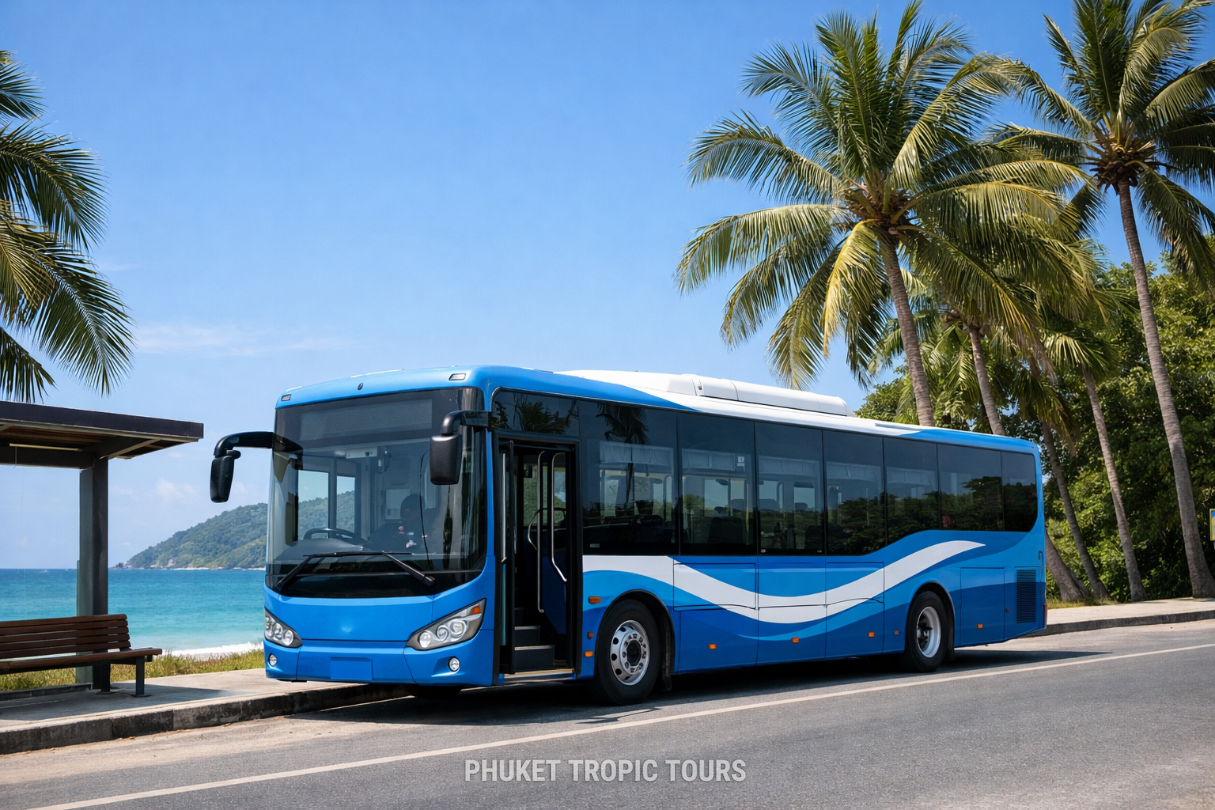
A tuk-tuk is rarely the cheapest way to get anywhere in Phuket. Three alternatives cover most journeys for a fraction of the price.
Grab and Bolt. Both apps work across the island. You see the price before you book, there is nothing to negotiate, and on beach-to-beach routes the fare is often 30 to 50 percent below the tuk-tuk quote. Cars are scarcer late at night and around Bangla Road.
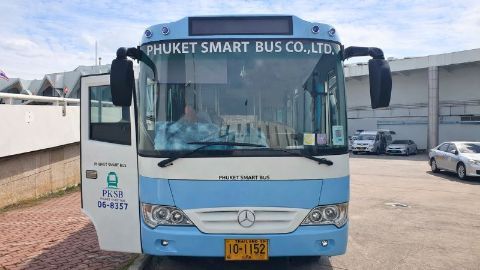
The Phuket Smart Bus. The air-conditioned bus runs the west coast between the airport and Rawai, stopping at Kamala, Patong, Karon and Kata, for roughly 50 to 170 baht depending on distance. It is slower than a tuk-tuk and worlds cheaper — see our guide to the Smart Bus in Phuket for timetables and stops.
Songthaews. The old blue open-sided trucks connect Phuket Town with the beaches for 30 to 50 baht. They run in daylight hours, roughly until early evening, and they are the local option rather than the tourist one.
For a straight comparison of car options and what a metered ride should cost, our article on taxis in Phuket covers the same routes.
When a Tuk-Tuk Is Still Worth It

None of this means you should avoid them. There are moments when a tuk-tuk is exactly the right call.
Late at night, when apps stop finding cars, a tuk-tuk is simply available. With a group of five or six, splitting 400 baht is cheaper per head than two app cars. And with luggage, a bicycle or a surfboard, that open back beats a sedan.
There is also the ride itself. Warm air, an open back and the coast road at sunset is a genuinely good twenty minutes, and one everybody photographs. Take one once for the experience, then use apps for the rest of the week.
If most of your days are going to be spent on the water anyway, transport matters less than you think — our Phuket tours include hotel pickup, and a full-day island-hopping day trip takes the whole transport question off your hands.
Conclusion
Tuk-tuks in Phuket are not a scam — they are an unmetered service with prices set by local stands, and tourists who do not know the numbers pay more than tourists who do. Now you know the numbers.
Agree the fare before you sit down, confirm it covers the whole car, keep small notes in your pocket, and check an app first on any longer run. Do that and the tuk-tuk goes back to being what it should be: a hot, noisy, oddly enjoyable way to get down the coast road.